
Harold and the Purple Crayon
Overview
Crockett Johnson’s Harold and the Purple Crayon is an American children’s picture book, written and illustrated by Johnson and first published in 1955 by Harper & Brothers. The 64-page book follows a young boy whose drawings become the world he moves through. Its spare images, restrained use of color, and concise storytelling make it an adventure that is easy for young readers to follow while leaving room for them to imagine what might happen next. Rather than treating pictures as decoration for a story told elsewhere, Johnson makes the act of drawing the engine of the plot: each new line changes Harold’s surroundings and determines what he must do.
Story and themes
One night Harold decides to take a moonlit walk. There is no moon to light the way and no path to follow, so he uses his purple crayon to draw both. He then travels through the world he is making as he goes, adding scenery and encountering the consequences of his own inventions. At one point he falls from a mountain and draws a balloon to catch him. When he finds himself in the ocean, he draws a small boat and uses it to escape. His adventure is a succession of problems, improvised solutions, and new directions. Eventually, Harold finds his way home and back to bed, bringing the imaginative journey to a reassuring close.
The book’s central idea is the power of imagination, but it also shows imagination as a form of practical agency. Harold does not merely picture a different world: his drawings create the circumstances he must navigate. A crayon can produce danger as well as opportunity, so making something new involves paying attention and responding to what one has made. Harold’s resourcefulness offers a child-sized model of problem-solving: he meets difficulty by thinking, drawing, and trying again. The story also suggests that a person can take an active part in shaping a route forward rather than waiting for the world to provide one. Its ending matters for the same reason. After ranging through an expansive imagined landscape, Harold is able to find his way back to the familiar safety of home.
Making and legacy
Johnson’s work as a cartoonist and art editor helps illuminate the book’s visual storytelling. The purple line is at once an image and an action; the scenery appears in response to Harold’s needs, while broad areas of white space invite readers to follow the marks and anticipate what they might become. The book’s simplicity is not a lack of invention. It is a carefully legible visual rule that allows the reader to see a character create, inhabit, and revise a world. In that respect, the book makes the process of storytelling visible without interrupting its adventure.
Johnson was already making children’s books before this title: he collaborated with writer Ruth Krauss, his wife, on The Carrot Seed, published in 1945. During the McCarthy-era Red Scare, Johnson was investigated because of his past work for left-wing publications; the investigation was closed in 1955 without conclusive evidence. The available information does not establish this as the direct cause of Harold and the Purple Crayon, but it forms part of the period in which Johnson was working. The book became the starting point for a series and inspired adaptations. It has sold more than 5.5 million copies and been translated into over fourteen languages. Its lasting place in children’s literature rests on its memorable central image and on a form of visual storytelling that treats a child’s invention as both play and a way to meet the world.
About the Author
Early life and education
Crockett Johnson was the pen name of David Johnson Leisk, born in New York City on October 20, 1906. He grew up in Elmhurst, Long Island, attended Newtown High School, and enjoyed sailing in Long Island Sound. Leisk later explained that people found his surname difficult to pronounce. He adopted “Crockett,” a childhood nickname, and joined it to his middle name, Johnson. He studied art at Cooper Union in 1924 and at New York University in 1925.
After his studies, Johnson held a varied assortment of jobs. He worked in an ice plant and in Macy’s advertising department, played professional football, contributed to magazines, and served as an art editor for several publications. These experiences preceded a career that crossed cartooning, children’s books, illustration, and painting. His path through commercial art and periodicals gave him a broad working life beyond the picture books for which he is now best known.
Work and creative range
Johnson’s syndicated comic strip Barnaby ran from 1942 to 1952 and became one of his major early achievements. In 1945, he collaborated with writer Ruth Krauss on The Carrot Seed. They had met in 1939 and later married; Krauss was Johnson’s second wife. The book’s concise story and images made it an important work in their shared contribution to children’s literature.
In 1955 Johnson wrote and illustrated Harold and the Purple Crayon, the beginning of a series of books about Harold and the work for which Johnson is best known. Its central device—a child drawing the world he then explores—joined visual invention directly to narrative. Johnson produced more than twenty books for children, according to his publisher. His interests extended beyond comics and children’s publishing: from 1965 until his death, he made more than one hundred paintings related to mathematics and mathematical physics. Around eighty of these works are held in the collections of the National Museum of Mathematics, reflecting his continuing interest in making abstract ideas visible.
Historical context and reputation
Johnson and Krauss shared opposition to fascism and racial discrimination and an interest in social reform. During the Red Scare of the McCarthy era, Johnson came under investigation because of his past work for left-wing publications and his political cartoons. The FBI investigation began in 1950 and ended in 1955; it was closed without conclusive evidence. This episode belongs to the history of the period and of Johnson’s working life, though it should not be treated as a simple explanation for the themes or form of his children’s books.
Johnson died in Norwalk, Connecticut, on July 11, 1975, aged 68. His lasting reputation rests especially on Barnaby and the Harold books, with Harold and the Purple Crayon remaining his most celebrated work. The image of a child making a path, a landscape, and a way out of danger with a purple crayon has become an enduring part of children’s literature. Johnson’s uncluttered visual storytelling gives young readers room to imagine alongside Harold, while demonstrating how images can create action and structure a narrative. His work is remembered both for its inventive simplicity and for the range of an artist who moved among cartoons, children’s books, and mathematically inspired painting.
StoryFlow
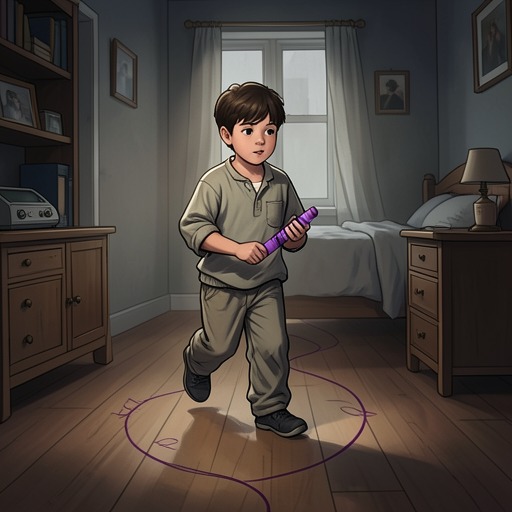
Harold's Moonlight Walk
Harold's intended stroll grows into an improvised journey and finally returns him to the bedroom he had hoped to find.
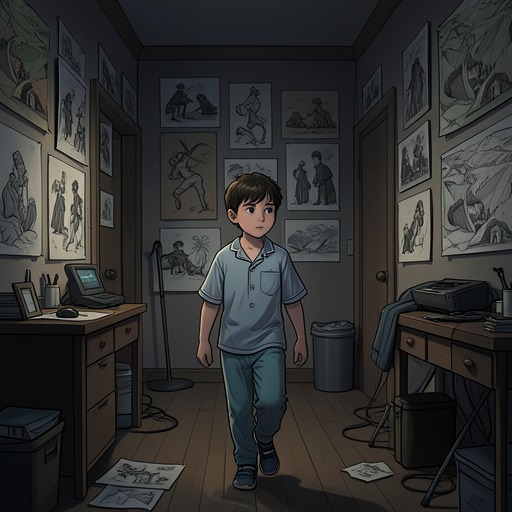
The Drawing Becomes a World
Harold's marks progress from useful props to a responsive environment whose dangers and possibilities he must navigate.

The Quest for the Bedroom Window
Harold moves from hoping to see his bedroom window to losing his bearings and finally remembering where that window belongs.
